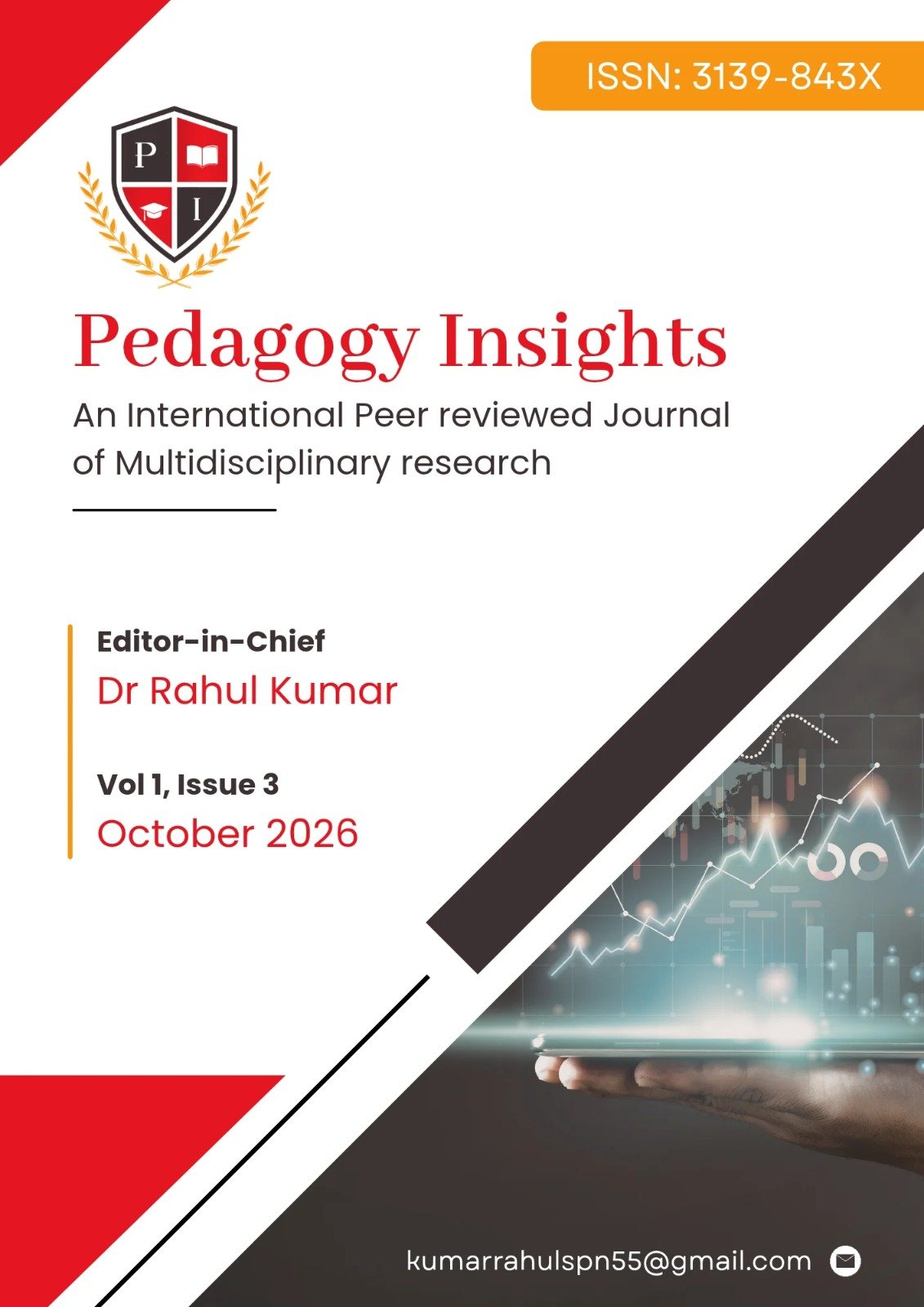
AI Literacy, Pedagogical Readiness, and Language Teaching Practices among Pre-Service English Teachers
DOI:
https://doi.org/10.5281/7e8zcw76Keywords:
Artificial Intelligence, AI Literacy, Pedagogical Readiness, AI-Supported Teaching, Future Secondary Teachers, Teacher Education.Abstract
Prospective teachers now face both new potential and challenges as artificial intelligence (AI) is increasingly incorporated into education, especially in the areas of instructional design, classroom delivery, assessment, and feedback. The current study looks at future secondary teachers' AI literacy, pedagogical preparedness, and AI-supported teaching methods. The study uses a descriptive survey research design and a quantitative methodology. A standardized questionnaire encompassing AI literacy, pedagogical preparedness, and reported AI-supported teaching methods is used to gather data. The data is analyzed using descriptive statistics, Pearson's correlation, Spearman's rank correlation, and Steiger's Z-test. The results show a reasonable degree of AI literacy overall (M = 3.46, SD = 0.78), with Evaluate and Create having the lowest mean (M = 3.16) and Use and Apply having the highest mean (M = 3.85). Similarly, pedagogical preparation is determined to be modest (M = 3.26, SD = 0.82), with relatively lower ratings in instructional delivery (M = 3.12) and AI-supported assessment (M = 3.11). AI literacy, pedagogical preparedness, and AI-supported teaching methods are significantly positively correlated, according to correlation analysis (r =.581,.379, and.428, respectively; p less than.001). Additionally, compared to AI literacy and reported practices, the link between pedagogical preparation and reported AI-supported practices is substantially greater (Steiger's Z = 2.80, p =.005). The study highlights the importance of strengthening practical AI competencies, pedagogical integration, and assessment-related capabilities within pre-service teacher education.
Downloads
Published
Issue
Section
License
Copyright (c) 2026 Author(s)

This work is licensed under a Creative Commons Attribution 4.0 International License.